Astronomers detected radio signals coming from an exoplanet for the first time. Spoiler alert: It's not aliens.
For the first time, astronomers have detected radio signals coming directly from a planet outside our solar system , according to a new preprint study . Spoiler alert: It's not aliens . But astrophys…
For the first time, astronomers have detected radio signals coming directly from a planet outside our solar system , according to a new preprint study . Spoiler alert: It's not aliens . But astrophysicists are still very excited about this discovery.
"Astronomers have been looking for radio signals from exoplanets for some time," Suzanne Aigrain , a professor of astrophysics at the University of Oxford who was not involved in the study, told Live Science in an email. "There have been tentative, indirect detections before, but this is the first truly convincing direct detection, and it hopefully paves the way for many more."
Artificial radio signals are a key focus in the search for extraterrestrial intelligence (SETI), which involves scanning the cosmos for signs of alien life . Such "technosignatures" could suggest advanced technologies built by intelligent extraterrestrial civilizations. However, radio signals can be emitted by natural sources, too.
"There are two natural processes that can produce radio emission in exoplanets," Aigrain said. "One is magnetic reconnection, when the planet orbits really close to the star and its magnetic field interacts directly with that of the star. The other is aurorae (like those we have on Earth and on other solar system planets like Saturn, but much stronger), when energetic charged particles streaming from the star interact with the upper atmosphere of the planet."
"This second effect is what the authors of the paper believe they have detected," Aigrain added.
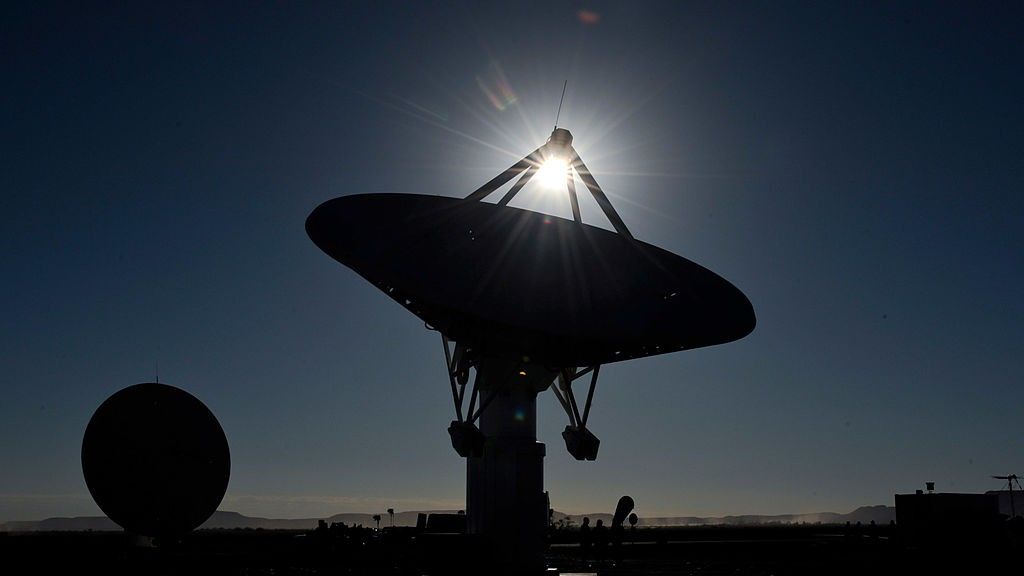
In the study, a research group led by Kevin Ortiz Ceballos , a graduate student at the Harvard and Smithsonian Center for Astrophysics, turned MeerKAT, a radio telescope array in South Africa, toward a massive gas giant called Beta Pictoris b, an exoplanet that's 64 light-years from Earth and has a mass roughly 10 times that of Jupiter, according to NASA . They picked up rapid, repeating bursts of radio signals coming from the planet.
At first, it wasn't clear whether the signal was coming from the planet or the star it orbits (named simply Beta Pictoris). However, after comparing the radio images of both the planet and the star with the positions of distant background quasars (bright, active galaxies that act as fixed reference points), the team confirmed that the radio bursts were indeed emanating from the gas giant.
Get the world’s most fascinating discoveries delivered straight to your inbox.
Read Full Story at Live Science →